20. Unlocking Our Experience:
Sensations, Feelings, Emotions & Thoughts

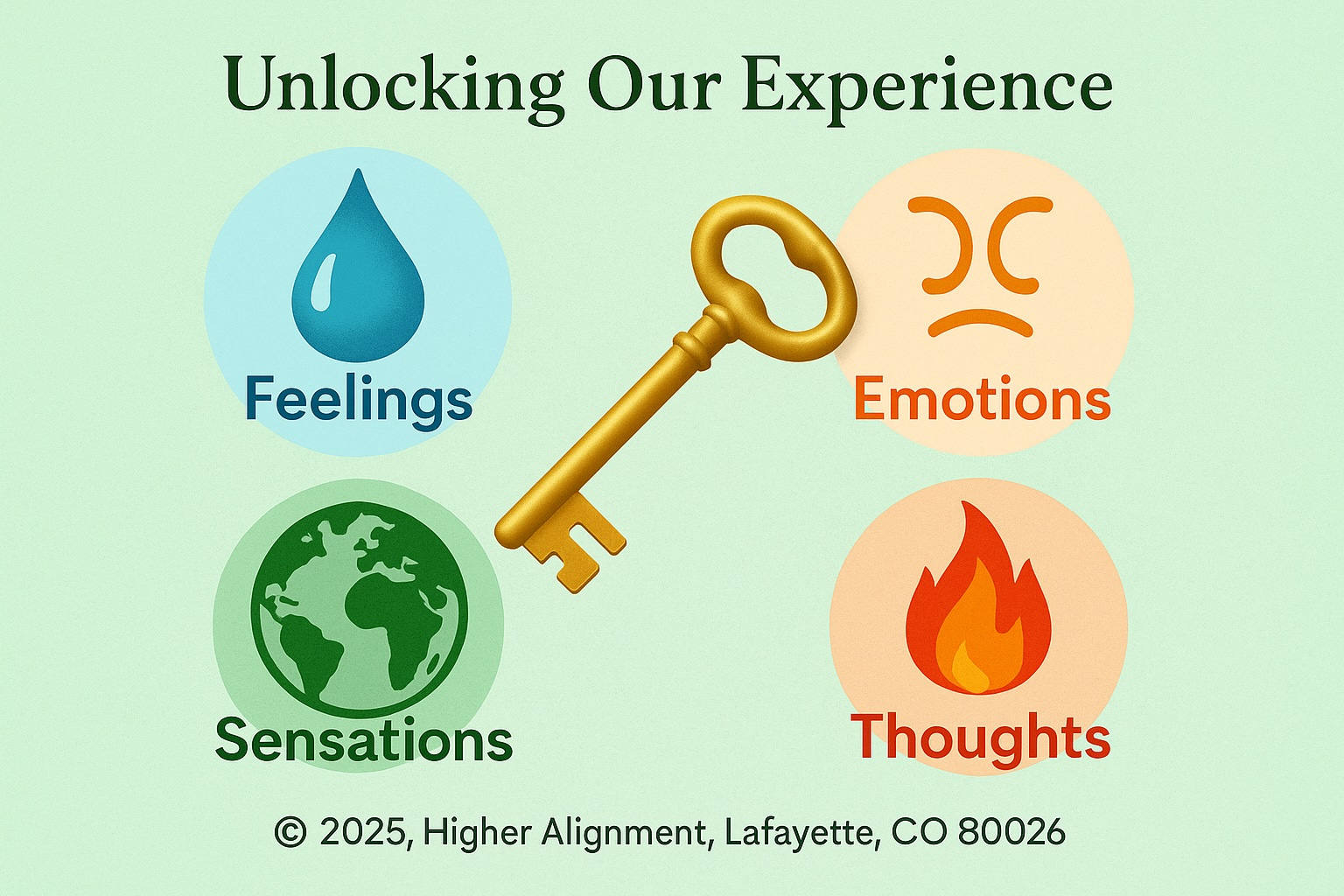
Let’s face it. Most of us learned how to hide what we really feel. We got good at “looking fine” on the outside while battling a full-blown spaghetti tornado on the inside. Welcome to the magical world of repression, where our true experiences go underground and try to text us through body tension, overreactions, and those weird dreams where we’re always late for an exam we didn’t study for. But what if we told you that you can unlock four core modalities—Sensations, Feelings, Emotions, and Thoughts—and finally make sense of your inner experience?
Let’s dive in.
What Are Modalities and Why Should I Care?
Each of us processes life through four channels of experience:
Sensations – the raw physical input from your body (touch, taste, pressure, temperature, etc.).
Feelings – internal states of well-being or discomfort; think of them as the tone or atmosphere of your experience (like warm connection or cool irritation).
Emotions – energetic reactions to circumstances with a personal storyline (joy, anger, sadness, etc.). Note: We typically feature many plots with diverse emotions in action.
Thoughts – conceptual or analytical interpretations (what something means, what we believe, what we fear). Note: Many individuals intellectualize their emotions to control or manage them.
Now, feelings and emotions often get lumped together, but here’s the key difference:
Feelings are spatial and contextual — they arise in the body and reflect how the situation resonates with us. They reflect our physical integrity. In our feelings, everything is now.
Emotions are expressive and energetic — they arise from judgment or investment in mental outcomes. In our emotions, we frequently shift our experience in time or add or subtract certain experiences by our self-focus. Emotions are like collages, when we mix and match qualities to motivate us.
When we’re aligned, these four modalities harmonize like a band. But most of us have one or more musicians who quit or never showed up. In these gaps, our blind spots are revealed by our incomplete perceptions. This creates co-dependent attractions where we need our partner to address and support us in our weak areas.
The Repression Game:
Overdoing, Underdoing, and Flip-Flopping
If you:
Avoid or minimize an experience (underdoing)
Amplify and obsess over it (overdoing)
Swing between extremes (flip-flopping)
...you’re repressing that modality. Repression isn’t failure—it’s a leftover survival strategy. But it limits Pleasure, Power, and Passion, and sets us up for mismatched relationships where we chase what we’re denying.
Repression often begins in childhood. If we had a parent who feared emotions, we learned not to cry or express joy too loudly. If our thoughts were criticized, we stopped sharing ideas. If our sensitivity was mocked, we tuned out our body’s wisdom. Repression is protection: “If I shut this down, I won’t get hurt.” But the cost is disconnection—not just from others, but from ourselves.
What’s sneaky about repression is how we act it out without knowing.
For example:
A repressed Feelings person may become a “fixer,” always trying to solve other people’s emotions but never their own.
A person with repressed Emotions may intellectualize everything, offering insight instead of vulnerability.
A repressed Sensations person might avoid physical intimacy or pleasure, blaming discomfort on “not being in the mood.”
A repressed Thinker may rely on intuition or others’ opinions, avoiding making decisions.
We take on roles to mask the missing pieces. But those roles become our identity, until one day we wonder why we feel stuck, misunderstood, or numb.
Pleasure, Creative Power, and Passion:
Repression’s Casualties
We all want to experience Pleasure, Power, and Passion—but repression chops these possibilities off at the knees.
Pleasure is not just about fun or indulgence—it’s about being in your body, savoring life without guilt. If we judge ourselves for wanting too much, or if we associate pleasure with danger, we shut down our capacity for joy. When we’re fully in our bodies and attuned to comfort, safety, and joy—voilà, pleasure! But if we replace true feeling with excitement (the hope that our desires will override our fears), we end up chasing highs and getting burnt out. Repressed pleasure makes everything feel muted—food tastes dull, hugs feel distant, and rest becomes a luxury instead of a necessity. We seek others to possess as a distraction to our internal void. We could also become a thrill seeker or addict for the adrenaline, drug, or dopamine-induced high.
Creative Power is the union of our emotions and thoughts. It gives us voice, direction, and impact. We declare what is meaningful for us. But repression convinces us we’re “too emotional” or “too intense” or “not smart enough.” It shames us by using the negative things others say to torment us. When our feelings and thoughts line up, we speak and act from truth. But when we get caught in intensity (proving ourselves, dramatizing everything), it’s a red flag that we’re not grounded in our truth. We dim our voice, overthink our decisions, or get trapped in comparison, competition, and corruption. We give our power away, then resent others for having it. There is Defensive Power, which is used to counteract the power of others, and Creative Power, which comes from aligning with others. Creative Power begins when we own our emotional truth and back it with coherent thought.
Passion arises when our feelings and emotions are integrated. It’s the spark that says, “This is my path.” It amplifies our self-importance or influence and control over others, or our humility and goodness with people. When we honor both our vulnerability and our expressiveness, we get fire without drama. But when we get stuck in anxiety (comparing, doubting, performing), we disconnect from our own path. Our doubt becomes taking on the Blame for our deficiencies and then projecting it on others who seem better. Repression here shows up as anxiety, people-pleasing, or avoidance. We over-edit our truth or imitate others’ passion because we’re unsure of our own. But passion can’t be borrowed. It grows when we feel and express ourselves without Blame.
Self-judgment is the engine behind all repression. It says: “This part of me isn’t lovable. I’d better hide it.” But hiding never works. What we hide festers and attracts attention like desperation, scarcity, and fear. What we feel, own, and express can finally breathe and live. This is a shift to creative self-abundance.
Reclaiming our modalities is a journey back to ourselves. It invites us to become whole, not perfect, but real. And in that realness, we find the roots of love, trust, and creativity. You don’t need to be someone else to be loved. You need to be fully yourself—felt, sensed, emoted, and thought-through. And the world needs that version of you the most.
Meet Judy and John: A Modality Meltdown
Judy and John have been married for five years. They love each other. But wow… communication is like a game of telephone played underwater.
Judy represses sensations (underdoes), overdoes on emotions, and flip-flops feelings.
John overthinks, represses emotions, and under-expresses feelings.
They argue like this:
Judy: “I can’t believe you just shut down like that!”
John: “I’m thinking! You’re always so emotional!”
Judy: “I have every right to feel what I feel!”
John: “And I have a right to not feel anything, thank you very much!”
Let’s decode:
Judy’s emotions are running the show, but her sensations (like body tension) are ignored. She doesn’t notice her shallow breathing or her fists clenching until much later.
John lives in his thoughts, rationalizing everything and avoiding vulnerability. He’s lost touch with how he actually feels in the moment.
This creates a disconnection. Judy wants passion. John wants peace. Both feel unmet.
Turning the Corner
One evening, they read an article about experiential modalities. John says, “So I repress emotions and feel nothing to feel safe?” Judy laughs, “And I’m hijacking every conversation with my mood swings?”
They begin checking in with each other:
“What are you sensing in your body right now?”
“What’s the tone or mood you’re in?”
“Any emotional waves coming up?”
“What are you telling yourself about this?”
At first, it’s awkward. But soon, they notice:
Judy feels more grounded when she stretches or takes a walk before reacting.
John gets more curious when he names an emotion (even if he doesn’t “like” it).
Their communication becomes multi-dimensional—less about being right, more about being real.
The Road to Pleasure, Creative Power, and Passion
To feel Pleasure, you need to be in your body, sensing the world and feeling its textures. If you’re caught in excitement, you’re likely overriding discomfort instead of addressing it. Aliveness, intent, and life energy could be your guide.
To claim Creative Power, you need to own both your emotions and thoughts. If you swing between proving and avoiding, you’re stuck in intensity, not integrity. Wisdom, comprehension and Light energy can be your guide.
To express Passion, you need your feelings and emotions to be in sync. Anxiety is a symptom of living someone else’s story. Radiant, Self-Unifying Love, authentic life expression and locating yourself in a spatial field of creative manifestation and joy could be your guide.
Practices to Reclaim Your Modalities
Body check-ins: Pause and ask, “What am I sensing right now?”
Feeling journaling: Name the vibe of your day without needing a reason.
Emotional awareness: Rate your energy from 1–10 and track what shifts it.
Thought catching: Write down repetitive thoughts and ask, “Is this even true?”
The goal isn’t perfection. Its presence.
Why It Matters
When you reclaim your modalities, you:
Communicate more clearly
Make better choices
Build deeper trust
Feel like yourself again
Would these elements uplift your consciousness?
You stop living through filters and start feeling your life.
This is how you make room for real love—not the performance of connection, but the experience of communion.
It begins with noticing when we’re reactive—and gently asking, “What am I protecting? What am I ready to feel?”
Reactivity pulls our energy, time, and space into a contractive, death-spiral.
It single-handedly enforces isolation, separation, and insulation in us.
Responsiveness is about stopping avoidance and finally meeting each other.
Welcome to the real you.
Larry,
Founder, Higher Alignment
this is amazing - thank you!