23. The Great Pretenders —
How Our Social Masks Sabotage Real Love

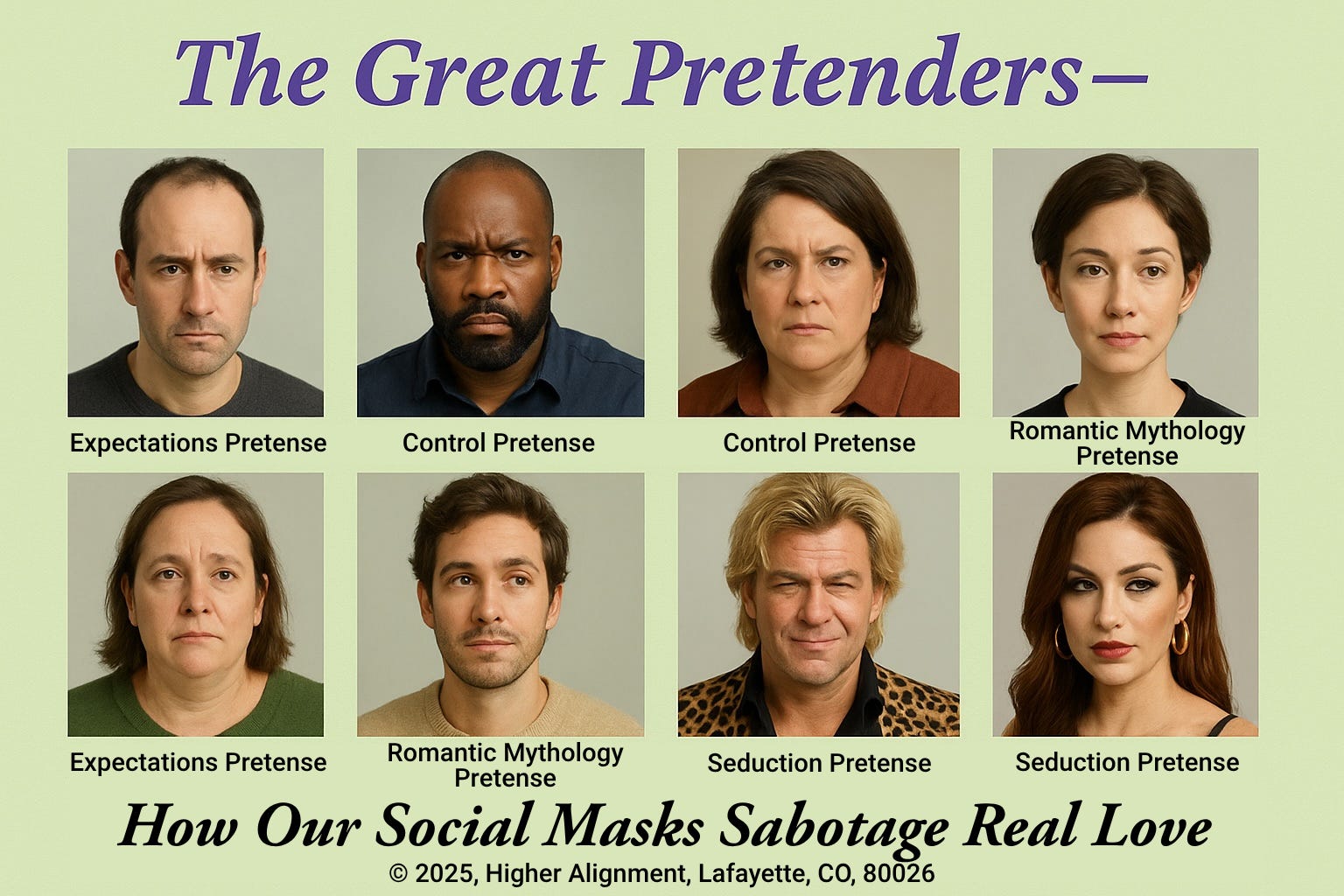
And What Dave and Teresa Can Teach Us About Dropping the Act
We all wear masks. Sometimes they’re charming, sometimes manipulative, and sometimes so ingrained that we think they’re who we are. These masks—called Pretenses in Higher Alignment—are strategies our egos use to get what they crave: attention, acknowledgment, acceptance, and adoration. But here’s the twist: pretenses promise intimacy yet secretly protect us from it. They are like empty gift boxes—wrapped beautifully, but nothing inside.
Let’s explore the four main pretenses, what they crave, what they fear, and how they entangle us:
1. The Expecter –
“The Approval Addict”
Wants: Attention
Fears: Being invisible
Pretense Pattern: “If I do enough for you, you’ll notice me.”
Behavior: Over-functioning. Needy gift-giving. Over-apologizing. Keeping score.
Attracted to: Seducers who seem shiny, confident, and popular.
Catch: They believe the only way to matter is to matter to someone else. Expecters usually fall flat when their silent sacrifices go unnoticed.
Expecters live for acknowledgment. They hover, hint, and help compulsively—not because they want to give, but because they desperately want to be seen. They don’t feel complete unless someone says, “Wow, I couldn’t have done this without you.”
2. The Controller –
“The Order Whisperer”
Wants: Acknowledgment
Fears: Being out of control or seen as unimportant
Pretense Pattern: “If I stay above it all and fix everything, I won’t have to feel anything.”
Behavior: Distance masked as responsibility. Silent resentment. Emotional bypassing.
Attracted to: Romantic Mythologists—who feel everything and want to heal them.
Catch: Their boundaries are secretly fragile. They need others to confirm their influence without asking for anything too… emotional.
Controllers crave structure, but more importantly, they crave subtle recognition for the emotional energy they never show. They don’t like emotional messes—so they take charge and then disappear.
3. The Romantic Mythologist –
“The Savior in Silk”
Wants: Acceptance
Fears: Being rejected for who they really are
Pretense Pattern: “If I romanticize this pain, it will become beautiful.”
Behavior: Over-identifying with suffering. Attraction to broken people. Belief in fate, signs, and “This means something.”
Attracted to: Controllers—who are the emotional puzzles they long to solve.
Catch: Their love stories are self-authored mythologies, often cast with characters who don’t want the role.
Romantic Mythologists wrap every flaw in a poetic backstory. They seek wounded partners so they can rescue them, redeem themselves, and validate their tender souls.
4. The Seducer –
“The Charmer on Cue”
Wants: Adoration
Fears: Being ordinary or undesirable
Pretense Pattern: “If I shine bright enough, no one will notice how hollow I feel.”
Behavior: Flirtation without follow-through. Validation-seeking. Inconsistent affection.
Attracted to: Expecters—who seem easy to impress and harder to disappoint.
Catch: They mistake admiration for connection and performance for power.
Seducers are all about the show—confidence, charisma, the ‘it factor.’ But behind the glitter is often deep insecurity. They crave being wanted but panic when someone wants to know them.
Pretenses as Scoring Systems
You can carry one, two, three, or all four pretenses—each one showing up more strongly in different situations.
We rate pretenses on a 0–3 scale:
0 = Minimal or no pretense. Authentic, grounded.
1 = Subtle. Used when insecure.
2 = Noticeable. Shapes behavior.
3 = Dominant. You believe the pretense is you.
Imposter Syndrome arises when our pretense strategies overtake our sense of authenticity. When we combine the four core pretenses—Expectations, Control, Romantic Mythology, and Seduction—we create a composite illusion that distances us from our Creative Self. Each of these pretenses can be scored from 0 to 3, with 3 reflecting a complete internalization of that distortion. When our total score across all four pretenses exceeds 7, we are likely navigating life through a false framework of perception—a hallmark of Imposter Syndrome.
Rather than showing up as who we truly are, we manage others’ impressions of us to avoid rejection or exposure. This overcompensation manifests as internal disaffiliation: we stop trusting our own voice and withdraw from our sense of creative contribution. At the same time, external distancing occurs—we fear being truly seen, lest others uncover the incongruence between who we are and the roles we play. Imposter Syndrome is not just an emotional unease—it is a warning sign that we are trapped in personality-level self-management rather than radiant self-expression.
Healing pretenses begins with the honest recognition that much of our energy has been spent trying to get others to want us—to admire, adore, approve of, and depend on us. Beneath this desire is often a subtle bargain: “If I meet your expectations, or perform for you, or play your ideal partner, then you’ll see me as valuable.” As we mature, we begin to see that these patterns—whether based on control, seduction, romantic mythology, or expectations—are not authentic expressions, but roles and desires we’ve adopted to feel self-important. Eventually, we realize we’ve been using these Pretenses to “need to be needed,” mistaking obligation for love and performance for connection.
The true turning point comes when we shift from managing impressions to revealing our truth. We start sharing who we are, not to be validated but to be known. The more we can reveal our creative gifts and obstacles, the better our connection. In this playful unfolding of our humanity, we discover that our imperfections are not liabilities—they are the very things that make us real, lovable, and whole. Healing, then, is not about fixing ourselves, but reclaiming ourselves—with humor, humility, and a deep appreciation for the creative spark we bring into the world.
Healing begins when we recognize the cost of these distortions (survival and success strategies) and reinvest in creative alignment. By becoming conscious of our pretenses, we reclaim the energy once spent on self-management and redirect it toward self-expression. Instead of seeking love through performance or protection, we learn to radiate love from within, unhooking from comparison, perfectionism, and the pressure to prove ourselves. As we dismantle pretenses, we restore our integrity, authenticity, and the courage to be ourselves. The antidote to Imposter Syndrome is not more achievement—it is creative alignment and radical self-acceptance.
The Case of Dave & Teresa:
How to Stop Acting Like Pretenders
Dave is a Controller/Seducer. He likes things tidy and sexy.
Teresa is a Romantic Mythologist/Expecter. She loves feelings and meaningful glances.
They met at a workshop on conscious intimacy (of course they did).
He was all charm. She was all “seen.”
Three weeks later: Chaos…
Teresa cried when Dave didn’t text goodnight.
Dave ghosted for a weekend after a “deep talk.”
Teresa assumed it meant he was “processing.”
Dave assumed she was too much.
They kept doubling down:
Dave posed more: “I’m just a guy who needs space.”
Teresa projected harder: “He’s my growth mirror.”
But they were both playing roles they didn’t even like.
Until one day, Teresa said (mid-sobbing),
“I just need you to want to love me back.”
And Dave replied (dryly),
“I’m exhausted trying to be interesting enough to keep you from panicking.”
Silence.
Then laughter.
Then truth.
They realized: their personas were dating—not their real selves.
The Cost of Pretenses
Pretenses:
Amplify Idealization (we sell a fantasy version of ourselves).
Insert us into problems we’re not equipped to fix.
Break down our boundaries, because we’re not honest about our real limits.
Waste time trying to look like a “good partner” instead of being one.
We end up drained, not because love is hard, but because acting is exhausting!
The Solution: Kill Your Character (Lovingly)
Here’s how to escape the Pretense Trap:
Spot the Pattern - What’s your script? Are you the savior, the boss, the pleaser, or the performer?
Score It Honestly - On a scale from 0–3, how deeply do you believe your pretense?
Own the Fear - Behind every pretense is a scared belief: “If I stop doing this, no one will love me.”
Name Your Need Without Drama - “I’m afraid I won’t be valued unless I’m useful/sexy/right/devoted.”
Practice Micro-Honesty - One sentence at a time: “That’s a performance. I don’t want to do that anymore.”
Let Others Surprise You - You don’t need to earn love. Show up without the mask. See who stays.
In Closing
Pretenses are survival tactics dressed as personality. But love doesn’t need them. In fact, love laughs at them.
When you stop trying to be lovable and just are, the right people show up and the wrong ones fade out.
So be like Dave and Teresa: drop the act, roll your eyes at your own drama, and fall in love—not with a fantasy, but with the messy, brilliant truth.
Curtain call.
Larry,
Founder, Higher Alignment