50. Skillful Partnering:
How To Start Building Together

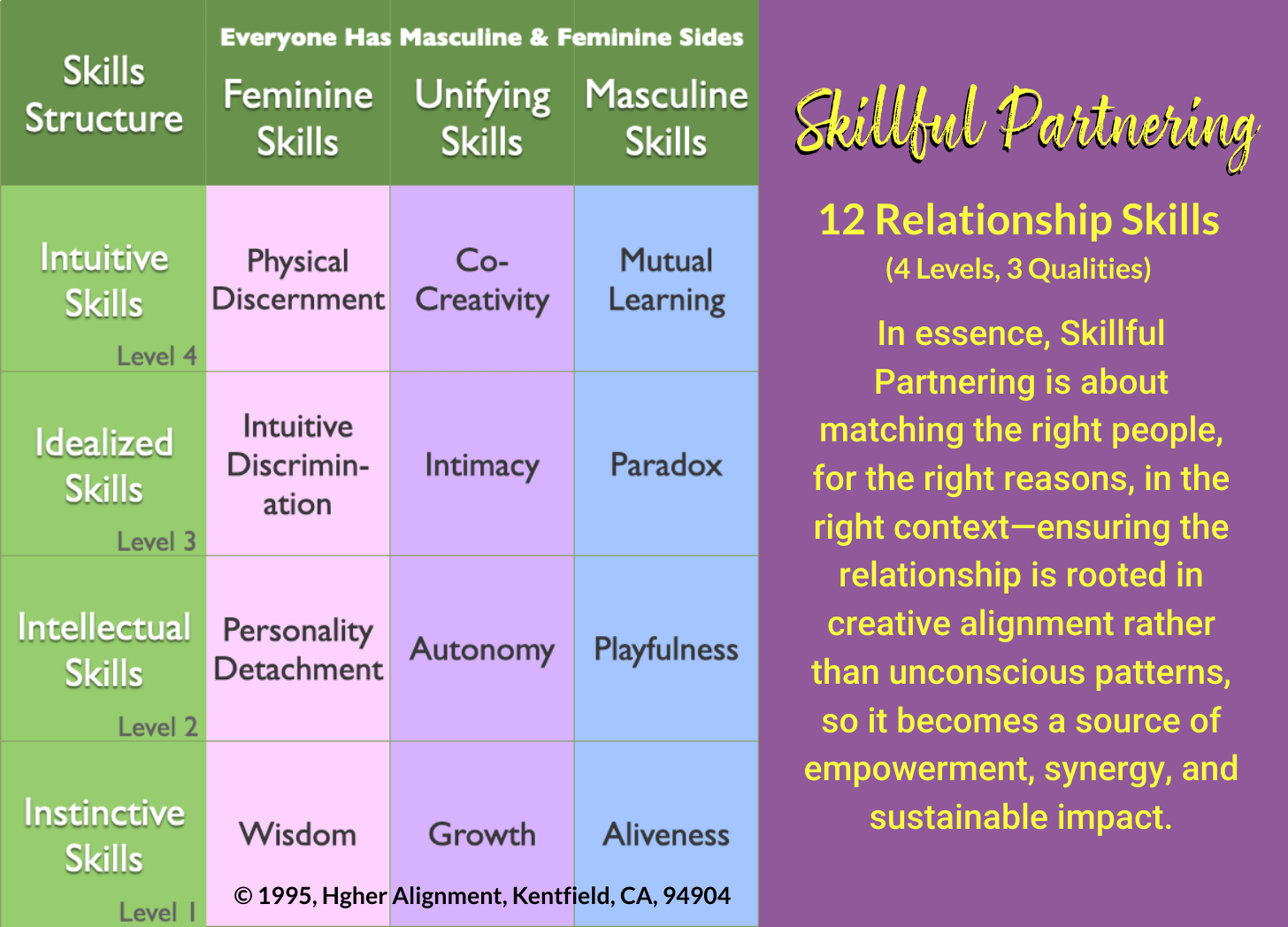
Relationship Skills are a commitment to Conscious Connection without compromise. It invites you to step up in your way of being present with others. The main benefit of developing Relationship Skills is that it promotes transpersonal development.
Relationships aren’t just about who we choose — they’re about how we work together once we’ve chosen. You can have the perfect partner on paper, but if your relationship skills are out of sync, you’ll be stepping on each other’s toes like two untrained ballroom dancers in steel-toed boots.
Higher Alignment calls these the Relationship Skills — the conscious tools that let us honor our own energy, time, and space while respecting those of others. They’re not just nice-to-have traits; they’re the operating system of Co-Creative relationships.
When unconscious, we default to Instinctive, Intellectual, and Idealized defensive patterns, each with its blind spots and breakdown patterns. When conscious, we focus on the Intuitive Relationship Skills that make effortlessness — that sweet, creative flow of Aliveness, Wisdom, and Awareness — possible.
With every Skill, we need to be able to detach from it to appropriately choose and implement it.
The goal? To move from using clumsy “me-first” skills to graceful Co-Creation. That’s where the magic happens — not just in romance, but in friendships, work, and family relationships.
What Drives Feminine, Masculine, and Unified Skills?
Feminine skills are driven by the urge to hold space and use energy effectively — to create safety, receptivity, and depth. They prioritize connection, inclusivity, and economy of engagement.
Masculine skills are driven by the desire to shape time and energy effectively — to protect, direct, and produce. They value clarity, tangible results, and an attraction to purpose.
Unified skills are driven by the goal of sustaining a shared framework — where safety, security, self-importance, and freedom coexist. It is an experiment in synthesis.
Level One – Instinctive Skills (Wisdom, Aliveness, Awareness)
At the Instinctive Level, we have a basic survival toolkit for relating who we are to who they are.
Feminine Skill – Wisdom
Wisdom is about holding presence in the face of intensity, rather than fleeing, forcing, or drowning in it. It is the ability to read the room — to sense what’s going on beneath the surface.
Intensity is the outward need to gain approval and conformance when we do not know the truth. Reactive Wisdom overuses intensity, either denying it (“I’m fine, everything’s fine…”) or drowning in it.
Conscious Wisdom is presence—the calm awareness that helps everyone breathe easier.
Projected Desire: “See me as insightful and trustworthy.”
Entitlement Trap: Assuming others should listen because you’re “right.”
Lesson: When we engage effort or pressure, it minimizes Presence.
Denials - Obstacles That Keeps Us From Making Choices:
We deny we are isolated, pretending to be connected.
Distant Defense – Denying intensity: “Let’s not make a big deal out of it.”
Dynamic Defense – Using intensity to control: “You should listen because I’m worked up about this.”
Disarming Defense – Losing ourselves in intensity: “I just got swept away and forgot what mattered.”
Affirmation - Invoking a Consciousness Within, So We Can Make a Choice:
Presence — staying grounded in what is.
Story:
Art notices Sally is pushing a project deadline forward without discussion. His instinct is to smooth things over (Disarming), but he catches himself and simply says, “I’d like to understand why we’re moving this up.” Sally, who tends to overplay her urgency (Disnamic), pauses. They talk through it calmly, and both realize the new date works better for their shared schedule.
Masculine Skill – Aliveness
Aliveness is bringing energy and enthusiasm into the space. Aliveness is sustained when energy is shared as an invitation, not withheld, weaponized, or self-consuming.
Excitement is a combination of fear and desire that prompts us to externalize our needs for connection and reassurance. Unconscious Aliveness either denies excitement, exploits it, or loses itself in it.
Conscious Aliveness is passion in the service of connection, not performance.
Projected Desire: “Notice my energy and join me.”
Entitlement Trap: Expecting others to match your tempo.
Lesson: Enthusiasm inspires when it invitesrather than demands.
Denials - Obstacles That Keeps Us From Making Choices:
I do not need to be here.
Distant Defense – Denying Excitement: “It’s not worth getting excited about.”
Dynamic Defense – Using excitement to dominate: “If I’m this hyped, everyone else should be too.”
Disarming Defense – Losing self in excitement: “I was so into it, I forgot everything else.”
Affirmation - Invoking a Consciousness Within, So We Can Make a Choice: Enthusiasm – joy that invites participation.
Story:
Sally brings a burst of energy to decorating their new space. Art joins in but feels himself getting too carried away, ready to repaint the entire house on a whim. He reins it back, focusing on what will keep the momentum enjoyable instead of exhausting.
Unifying Skill – Growth
Growth is the willingness to change and evolve through relationships. Growth occurs when change is encouraged as a shared journey, rather than being resisted, imposed, or outsourced.
Reactive Growth swings between over-directing others’ growth and neglecting your own. Relationship Skills are designed to fine-tune our way of connecting so reactive elements do not intrude.
Conscious Growth fosters mutual evolution without keeping score.
Projected Desire: “Acknowledge my progress.”
Entitlement Trap: Expecting applause for every baby step.
Lesson: Change is affirmed by living it, not narrating it.
Denials - Obstacles That Keeps Us From Making Choices:
I do not dance in your parade.
Distant Defense – Ignorance: “I don’t need to change.”
Dynamic Defense – Over-directed growth: “I’ll tell you exactly how to improve.”
Disarming Defense – Under-directed growth: “I’ll change if someone else pushes me.”
Affirmation - Invoking a Consciousness Within, So We Can Make a Choice: Change — evolving naturally through openness.
Story:
Art feels stuck in a rut with their shared art projects. Sally’s instinct is to give him a growth plan (Dynamic), but she realizes that won’t help. Instead, she shares what inspires her and invites him to explore alongside her.
Level Two – Intellectual Skills (Personality Detachment, Playfulness, Autonomy)
Moving from reactive survival to conscious structure.
Feminine Skill – Personality Detachment
Personality Detachment is freedom from being owned by what we have, think, or feel. It is the ability to separate self-worth from surface identity. The more we hold on to our attachments, the less we can see beyond them.
By ownership of attachments, we become possessed, which drives us to possess others. Reactive Personality Detachment clings to physical, intellectual, or emotional attachments for a sense of security.
Conscious Personality Detachment allows freedom of choice without being possessed by roles or opinions.
Projected Desire: “Value me beyond my labels.”
Entitlement Trap: Expecting credit for “not being attached” while secretly still attached.
Lesson: Detachment isn’t distance — it’s perspective.
Denials - Obstacles That Keeps Us From Making Choices:
I need form and substance before you.
Distant Defense – Physical attachments: “I am my possessions and appearance.”
Dynamic Defense – Intellectual attachments: “My ideas define me.”
Disarming Defense – Emotional attachments: “If you challenge me, you reject me.”
Affirmation - Invoking a Consciousness Within, So We Can Make a Choice: Freedom of choice — being unpossessed by identity.
Story:
Sally critiques one of Art’s design ideas. His Disarming side wants to take it personally, but instead, he steps back, sees the value in the feedback, and reworks the piece without feeling diminished.
Masculine Skill – Playfulness
Playfulness thrives when structure supports, but doesn’t strangle possibilities. This is the skill of introducing lightness, humor, and spontaneity.
Conditioning, Defenses, and Pretenses minimize playfulness, so everything becomes serious. Reactive Playfulness is over-planned “fun” or people-pleasing.
Conscious Playfulness is non-critical creativity that opens possibilities.
Projected Desire: “Enjoy life with me.”
Entitlement Trap: Assuming your sense of fun works for everyone.
Lesson: Play works best when it’s mutual and free of guilt.
Denials - Obstacles That Keeps Us From Making Choices:
I want you to respond to me.
Distant Defense – Meeting expectations: “Fun is only for when everything’s done right.”
Dynamic Defense – Over-planning fun: “We must schedule every moment.”
Disarming Defense – Under-planning fun: “We’ll just wing it and hope it’s fun.”
Affirmation - Invoking a Consciousness Within, So We Can Make a Choice: Multiple possibilities — non-critical, open enjoyment.
Story:
Sally proposes a game night. Art suggests a few ideas without locking in too rigidly, letting them decide together. It turns into a spontaneous mix of board games and music — fun without pressure.
Unifying Skill – Autonomy
Autonomy is owning your space and choices while honoring the space of others. It occurs on two levels, internally in creating our truth and externally in accepting the truth of others.
If we are not in resonance or alignment, we are not effective in working together. Autonomy allows us to select what is important in alignment. It’s about declaring and maintaining healthy boundaries.
Reactive Autonomy confuses independence with isolation or avoids connection to protect freedom.
Conscious Autonomy holds personal truth while respecting others’ space.
Projected Desire: “Respect my space and choices.”
Entitlement Trap: Expecting freedom without accountability.
Lesson: True autonomy thrives in mutual esteem and respect. We need to honor our energy, time, and space so that we can do so with others.
Denials - Obstacles That Keeps Us From Making Choices:
I make my own independent decisions.
Distant Defense – Confusion (denying life energy): “I’m not sure what I want.”
Dynamic Defense – Personal autonomy denial (denying time/truth): “I can’t make space for myself.”
Disarming Defense – Interpersonal autonomy denial: “I can’t hold space for me and still connect with you.”
Affirmation - Invoking a Consciousness Within, So We Can Make a Choice: Freedom — balancing independence and connection.
Story:
Sally wants a weekend alone to recharge. Art’s Disarming impulse is to tag along, but he affirms her choice and uses the time to focus on his own projects.
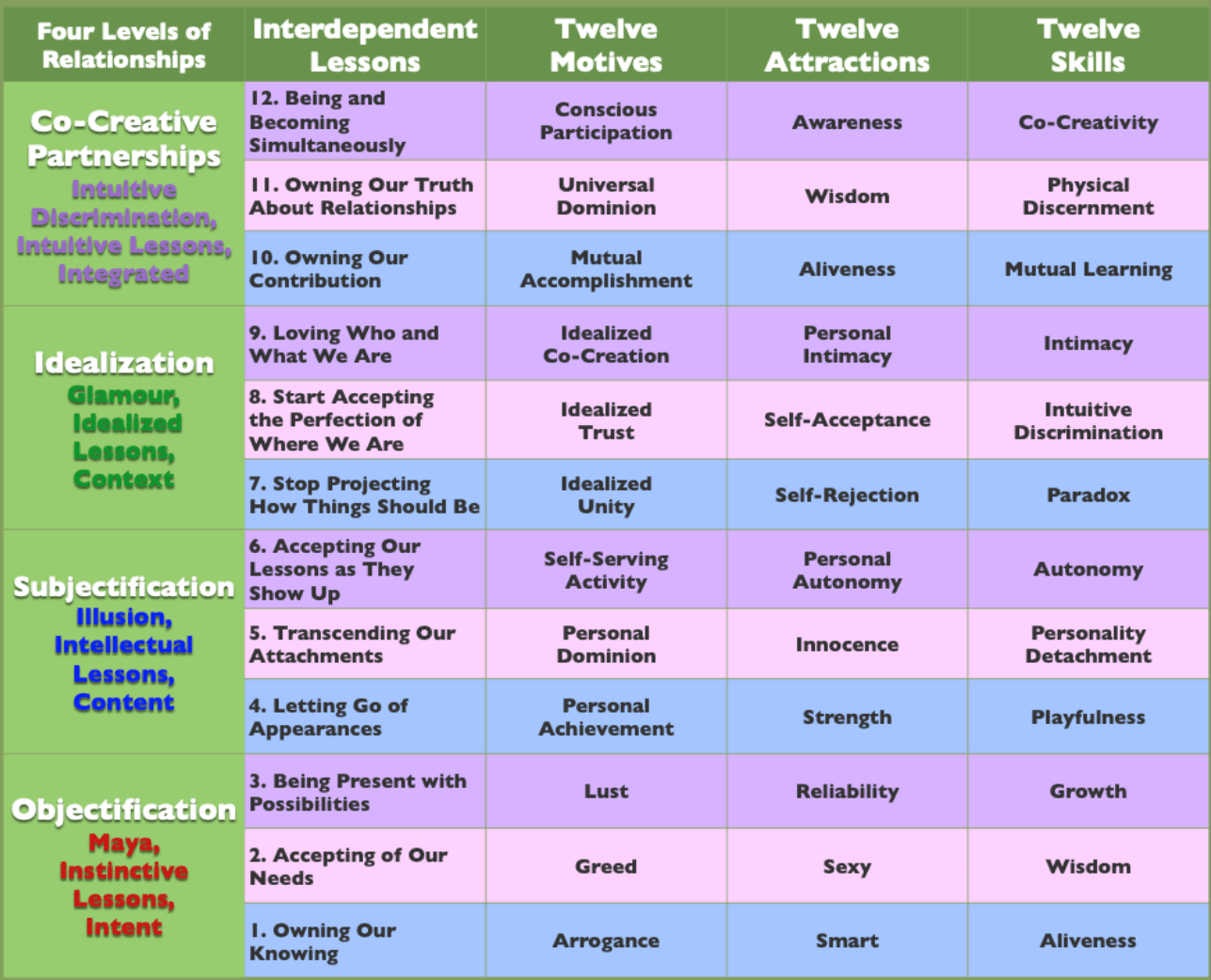
Level Three – Idealized Skills (Depth, Subtlety, Vulnerability)
We now move from fixed ideas of survival and success to using our imagination to create a more fluid and unpredictable relationship.
Feminine Skill – Intuitive Discrimination
Intuitive Discrimination sees fully before choosing. Seeing the whole picture — balancing sensation, feeling, emotion, and thought.
Certainty about false assumptions is the hallmark of defensive distortion blindness. Not falling into defensive distortions means that we can operate with inner and outer knowing combined.
Reactive Intuitive Discrimination distorts through objectification, subjectification, or idealization.
Conscious Intuitive Discrimination fully embraces all modalities before making a judgment.
Projected Desire: “Trust my discernment.”
Entitlement Trap: Acting on partial truth but selling it as the whole.
Lesson: Discrimination is a complete embrace, not a quick verdict.
Denials - Obstacles That Keep Us From Making Choices:
What I know is more important than you.
Distant Defense – Objectification: “Seeing only surfaces.”
Dynamic Defense – Subjectification: “My view is more valid than yours.”
Disarming Defense – Idealization: “Putting you on a pedestal.”
Affirmation - Invoking a Consciousness Within, So We Can Make a Choice: Balanced embrace — honoring all experience modalities equally.
Story:
Sally presents a bold new idea. Art resists idealizing it just because it’s hers, instead weighing its merits across practicality, emotion, and aesthetics. They adapt it together.
Masculine Skill – Paradox
Paradox expands possibility by holding opposites without collapse. It is the ability to hold differences and similarities simultaneously without forcing resolution.
Reactive Paradox disengages from differences or similarities to avoid discomfort.
Conscious Paradox sees both without preconceptions.
Projected Desire: “See the complexity I see.”
Entitlement Trap: Expecting others to live comfortably in ambiguity.
Lesson: Paradox expands options when it’s lived, not explained.
Denials - Obstacles That Keep Us From Making Choices:
You can never keep up with my complexity.
Distant Defense – Certainty: “Only one truth.”
Dynamic Defense – Disengagement from differences: “Let’s ignore our disagreements.”
Disarming Defense – Disengagement from similarities: “We’re nothing alike.”
Affirmation - Invoking a Consciousness Within, So We Can Make a Choice: Seeing both differences and similarities without preconception.
Story:
Art and Sally disagree on the style of a project. Instead of pushing for his way or retreating, Art suggests they integrate both approaches, creating something richer.
Unifying Skill – Intimacy
Intimacy is real when it’s mutual and self-respecting. It is an energetic and spatial experience that is introspective and whole, and creates the capacity for full vulnerability and presence.
There are sexual, role-based, personal, interactive, and impersonal forms of intimacy.
Reactive Intimacy avoids connection, fakes it, or enmeshes.
Conscious Intimacy is open-hearted without losing self.
Projected Desire: “Be with me, fully.”
Entitlement Trap: Expecting instant closeness without building trust.
Lesson: Intimacy is co-created, not demanded.
Denials - Obstacles That Keeps Us From Making Choices:
I open up when I am secure to do so.
Distant Defense – Avoidance: “I don’t do vulnerability.”
Dynamic Defense – Non-personal intimacy: “Pretending to connect.”
Disarming Defense – Other-personal intimacy: “Enmeshment.”
Affirmation - Invoking a Consciousness Within, So We Can Make a Choice: Full participation — present and open.
Story:
During a tense week, Sally asks Art how he’s feeling. He resists slipping into vague platitudes (non-personal) or over-merging with her mood. Instead, he shares clearly and listens in return.
Level Four – Intuitive Skills (Physical Discernment, Mutual Learning, Conscious Co-Creativity)
Mastery tools for co-creative flow.
Feminine Skill – Physical Discernment
Physical Discernment respects body wisdom for self and others, sensing physical and energetic alignment. Physical alignment is important to recognize timing and spatial differences and similarities.
Reactive Physical Discernment resists participation or over-accommodates others’ needs at personal expense.
Conscious Physical Discernment aligns action with both energy and form.
Projected Desire: “Trust my sense of what’s right for the body and space.”
Entitlement Trap: Assuming your physical comfort is universal.
Lesson: Discernment starts with self-awareness.
Denials - Obstacles That Keeps Us From Making Choices:
My body awareness reveals the deeper truths.
Distant Defense – Passive resistance: “Not participating physically.”
Dynamic Defense – Over-accommodation: “Ignoring my needs for yours.”
Disarming Defense – Safety show: “Pretending I’m doing this for you when it’s for me.”
Affirmation - Invoking a Consciousness Within, So We Can Make a Choice: Alignment to the body’s truth and energy.
Story:
Sally wants to try a new physical activity. Art checks in with his body first, then joins in enthusiastically, knowing it feels right for both.
Masculine Skill – Mutual Learning
Mutual Learning thrives on co-discovery. It is the ability to remain open to influence while influencing others.
Mutual Learning provides an invitation to new ways of experiencing the world through your partner’s eyes. It requires accepting our ability to change, grow, and strive before we develop new ways of connecting.
Reactive Mutual Learning makes unilateral decisions, pushes others away, or withdraws when challenged.
Conscious Mutual Learning involves joint exploration and adapts its pace to both parties.
Projected Desire: “Learn with me.”
Entitlement Trap: Wanting the other to change faster than you do.
Lesson: Learning is mutual, or it’s not learning.
Denials - Obstacles That Keeps Us From Making Choices:
Knowledge confers power and position.
Distant Defense – Unilateral decisions: “I’ll decide for both of us.”
Dynamic Defense – Pushing others away: “You’re not ready, so I’ll do it alone.”
Disarming Defense – Withdrawal: “I’ll just hide until it’s safe.”
Affirmation - Invoking a Consciousness Within, So We Can Make a Choice: Openness to change, growth, and striving together.
Story:
Art and Sally explore a new art medium. Instead of Sally taking over or Art disappearing, they experiment side by side, adapting together.
Unifying Skill – Conscious Co-Creativity
Co-Creativity is balanced, conscious, and equally invested, integrating Life, Light, and Love equally in joint action. It requires seeing the larger picture and being able to follow it into our or our partners’ depths.
Reactive Creativity imitates, personalizes, or collaborates superficially.
Conscious Co-Creativity is a balanced, inspired creation.
Projected Desire: “Make something real with me.”
Entitlement Trap: Expecting Shared Credit for One-Sided Effort.
Lesson: Co-Creation thrives on equal investment.
Denials - Obstacles That Keeps Us From Making Choices:
Creativity is dangerous in other hands.
Distant Defense – Imitation: “No life, light, or love.”
Dynamic Defense – Personal creativity only: “Some life but not love.”
Disarming Defense – Interactive creativity only: “Some life but not light.”
Affirmation - Invoking a Consciousness Within, So We Can Make a Choice: Equal Life, Light, and Love in creation.
Story:
Art and Sally design an event. They consciously ensure it includes inspiration (light), emotional resonance (love), and practical value (life), making it memorable for everyone.
Art & Sally: The Skill Gap Shuffle
Art is stacked with feminine skills — Wisdom, Personality Detachment, Intuitive Discrimination, and Intimacy — plus a couple of masculine skills, such as Physical Discernment, Paradox, and Playfulness. Sally’s strengths are more balanced, but they include masculine heavyweights — Aliveness and Autonomy — and shared territories like Wisdom, Intimacy, and Intuitive Discrimination.
Where they meet, they shine:
Wisdom lets them read each other’s moods without words.
Intuitive Discrimination helps them navigate tricky choices without drama.
Personal Intimacy makes them feel at home in each other’s presence.
Where they don’t overlap, it’s more awkward. Art sometimes feels “left out” in skills like Autonomy, wondering if he’s even needed. Sally sometimes feels Art retreats into mapping skills on his own instead of using them with her. Their creative projects hover around “half successful” because their flow gets interrupted by mismatched skill sets.
When they finally sit down and look at the skill map together, two things happen:
Sally realizes she’s more powerful when she balances her skills and asks for what she needs (Autonomy in action).
Art sees that building mutual esteem will help him step into autonomy without losing connection.
With practice, Sally coaches Art to claim his time, space, and energy — not in defiance, but in a balanced way. Art, in turn, encourages Sally to slow down enough to enjoy the Co-Creation, not just the results.
They’re not perfect, but each time they consciously develop a skill in sync, the co-dependence patterns weaken, and their Co-Creative potential grows. Their best moments are when Radiant, Self-Unifying Love feels not just possible but already happening.
The Insight
Relationship Skills aren’t just “how we get along” — they’re how we build anything together. We need to connect, communicate, co-measure, and Co-Create together to achieve this level of expression. It is all about communion and mutual influence that builds our transpersonal consciousness.
Without conscious Skills, we fall back on defensive patterns. Therefore, we need to affirm our own outreach program, called Relationship Skills, and prevent this Tower of Babel disaster. With self-affirmations, we create a framework where interconnection is simple, open, and effortless.
Motives set our purpose, Attractions draw us together, and Skills keep us in motion without collision. Master all three, and you stop tripping over each other… and start building something worth dancing for. These consciousness tools reveal how we become aware in relationships, step by step.
Manifesting Our Path Together,
Larry,
Founder, Higher Alignment