48. Mastering Motives:
12 Actions That Define Our Direction

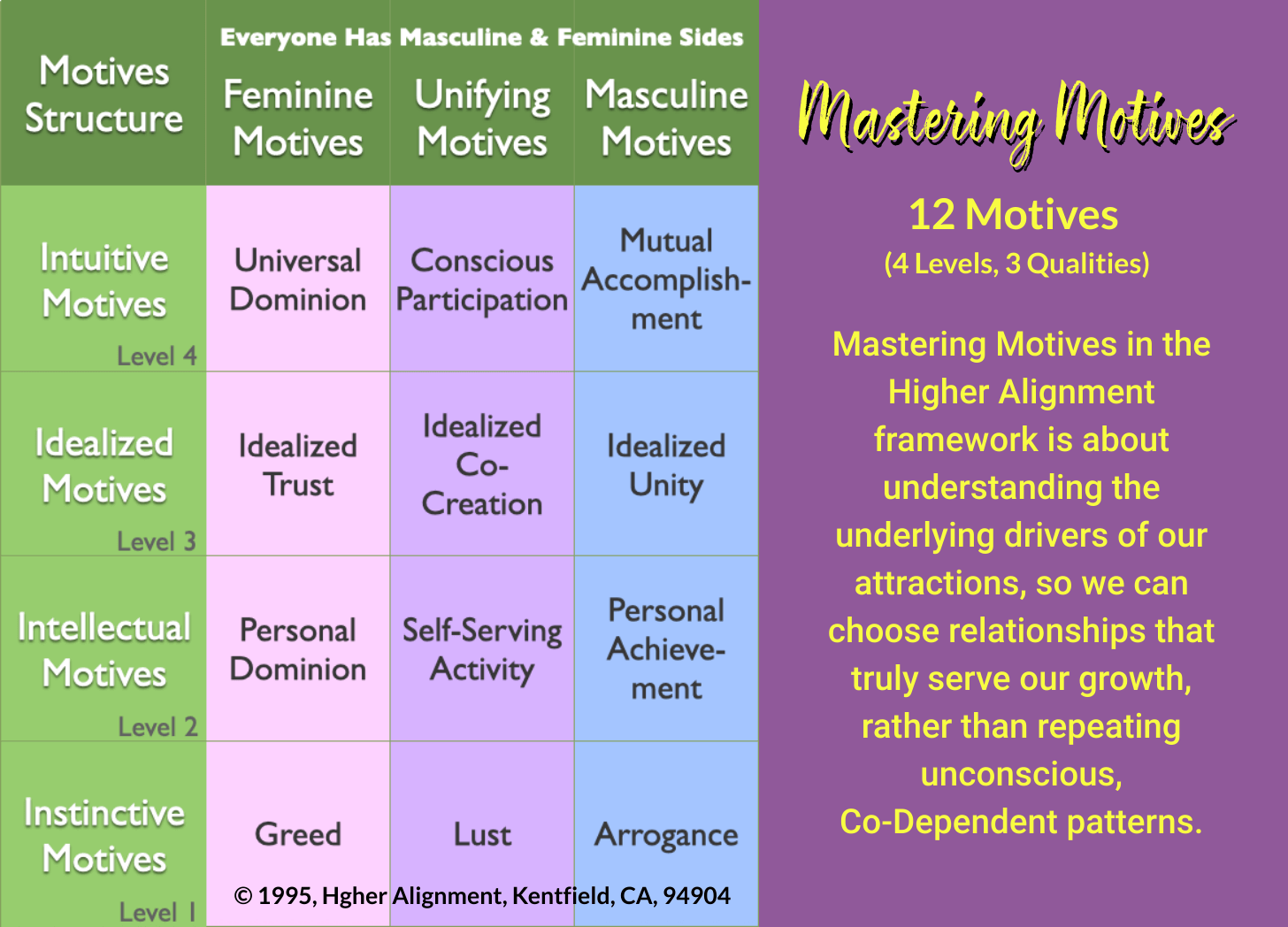
Motives are like the secret fuel tanks under the hood of our lives. They fuel our actions, guide our direction. The trouble is, most of us are driving without checking what’s in the tank — and sometimes we discover we’ve been running on low-grade gas that smells suspiciously like ego fumes.
When we’re unconscious, we bounce between reactive Instinctive, Intellectual, and Idealized Motives — like toddlers with power tools — trying to get what we want while avoiding what we fear.
When we’re conscious, we aim for the gold: the Intuitive Motives of Universal Dominion (a space of connection to all things around us), Mutual Accomplishment, and Conscious Participation. That’s the grown-up table of Motives, where we move from competition to cooperation. That’s where service and Co-Creation become more important than “me getting my way.”
Our personality is isolated and works like an ego reinforcement process to give us a false sense of competence when we don’t know what is going on. Our personality is a random generator of reactive beliefs, conflicts, and fears that make it difficult to feel a sense of unity within us.
The fun part? These Motives aren’t random. They follow a sequence: three at each level, moving from feminine to masculine to unifying energies. And when you master one side (masculine productivity or feminine space-holding), you begin to integrate the opposite, generating more energy and moving from Lust (the lowest level) to Conscious Participation (the highest level).
Let’s unpack all twelve motives, with plenty of real-life examples — including our friends Beth and Steve, who are about to find out that their problem isn’t that they’re incompatible… It’s that their motives aren’t dancing to the same song.
The Instinctive Level:
Where We Start in Survival Mode
Instinctive motives are our base operating system. They’re loud, simple, and often self-focused. Think “hungry toddler,” “territorial cat,” or “politician on Twitter.”
1. Greed (Feminine, Instinctive)
Purpose: To accumulate enough resources to feel safe. In the unconscious state, it hoards for security; in the conscious state, it can become generous through abundance.
Attraction/Repulsion: Attracts those who think you’ll share; repels anyone tired of competing for crumbs.
Beth never had much of a Greed issue — unless you count her habit of collecting knick-knacks, most of which she never thinks about. Steve, however, suspects she’s hoarding “space in the garage” he’d like for his kayak rack.
2. Arrogance (Masculine, Instinctive)
Purpose: To project superiority so others won’t question your right to exist.
Attraction/Repulsion: Attracts people who want a strong protector; repels those allergic to condescension.
Steve’s Arrogance shows up in meetings: “Beth, your art installation is great, but let’s talk about whether it’s efficient.” He is confident that he is right. Beth calls it “mansplaining with bullet points.”
3. Lust (Unifying, Instinctive)
Purpose: To connect physically or energetically to feel stimulated. At its lowest, it’s impulsive, motivated by conflicted Motives; at its highest, it’s a channel for vitality and creativity.
Attraction/Repulsion: Attracts excitement-seekers; repels those wanting aliveness.
Beth’s Lust comes out in capricious road trips, where she gives herself permission to do what she wants. Steve’s version is buying power tools without reading the manual, doing something that challenges the status quo, or taking a risk. Neither works well when they are acting out of their conditioning.
The Intellectual Level:
The Land of Plans and Proof
Here, we graduate from pure survival to tactics because we want to feel accomplished. Intellectual Motives drive toward control, efficiency, recognition, and measurable outcomes.
4. Personal Dominion (Feminine, Intellectual)
Purpose: To establish control over your environment so you can feel empowered.
Attraction/Repulsion: Attracts people who like decisive leaders; repels free spirits.
Beth’s Personal Dominion is about her creative studio. She has a “no shoes past this line” rule. Steve once forgot… and heard about it for a week.
5. Personal Achievement (Masculine, Intellectual)
Purpose: To accomplish visible, measurable goals.
Attraction/Repulsion: Attracts those inspired by success; repels anyone feeling compared or judged.
Steve lives here. Spreadsheets, deadlines, and “progress reports” are his love language. When Beth talks about a project’s “energy,” he replies, “But… did it ship?”
6. Self-Serving Activity (Unifying, Intellectual)
Purpose: To structure life to maximize personal benefit. It can evolve into “self-aligned productivity” when conscious.
Attraction/Repulsion: Attracts opportunists; repels collaborators.
Beth suspects Steve’s “help” in her art show was really about networking with the gallery owner. Steve insists it was “strategic co-branding.”
The Idealized Level:
Dreamy, Seductive but Dangerous
Idealized Motives operate in the world of vision, values, and lofty expectations. They can inspire… or set you up for a spectacular disappointment.
7. Idealized Trust (Feminine, Idealized)
Purpose: To believe the best in others, sometimes against all evidence.
Attraction/Repulsion: Attracts the wounded who want to be seen; repels cynics.
Beth trusts easily. Steve thinks her vetting process for new friends is “they have a nice energy.” This is blind trust.
8. Idealized Unity (Masculine, Idealized)
Purpose: To merge efforts under a shared vision. Assumes that everyone else knows how smart we are, so they will not directly challenge us.
Attraction/Repulsion: Attracts joiners; repels rugged individualists.
Steve loves unity… if everyone agrees with his version of the plan. Beth has noticed.
9. Idealized Co-Creation (Unifying, Idealized)
Purpose: To build something transcendent together.
Attraction/Repulsion: Attracts Visionaries; repels those without patience for the process.
Beth’s happiest moment was when Steve helped design the layout for her art opening. His happiest moment was when the last guest left and he could pack up. Both of them have different objectives about how things would work out. Idealized Co-Creation is a blind trust that everything will work out.
The Intuitive Level:
The Grown-Up Table
This is where the air is clear, the view is wide, and service becomes more important than self-protection.
10. Universal Dominion (Feminine, Intuitive)
Purpose: To take stewardship of your gifts and environment for the good of all.
Attraction/Repulsion: Attracts co-stewards; repels hoarders and petty controllers.
Beth feels this when she curates community art events. Steve sees her light up and admits, “Okay, this matters more than I realized.”
11. Mutual Accomplishment (Masculine, Intuitive)
Purpose: To align efforts so everyone benefits.
Attraction/Repulsion: Attracts collaborators; repels exploiters.
Steve’s happiest breakthrough was realizing his project management could amplify Beth’s creativity instead of “managing” it.
12. Conscious Participation (Unifying, Intuitive)
Purpose: To fully engage life as a creative, Co-Creative act.
Attraction/Repulsion: Attracts everyone ready for the real work; repels cynics, saboteurs, and spectators.
When Beth and Steve hit this motive together, it’s magic: his structure and her vision lock in, and suddenly they’re that couple everyone wants to collaborate with.
Beth & Steve: The Motive Tango
When we met them, Steve’s Intellectual Motives were resisting Beth’s Idealized Motives. He wanted concrete timelines; she wanted a shared vision. The few times they succeeded were when Steve felt obligated to help on Beth’s creative projects — and accidentally enjoyed himself.
Once they learned about Motives, it got interesting.
Beth saw her strength in Feminine Motives — holding space, trusting process, connecting vision.
Steve saw his strength in Masculine Motives — tools, time, tangible results.
They also realized their polarity was the source of attraction and frustration. They weren’t broken; they were just playing different songs.
The big insight? If they could embody the same Motive at the same time, they’d stop wasting energy on translation. Most individuals are attracted to their masculine or feminine complements, which means that individuals tend to take up an internal residence (one related to their role at home and one related to their role at work) and not share simultaneously with each other. A good example of this on a competitive/intellectual level is where one takes care of the household (Personal Dominion) and one takes care of earning a living (Personal Achievement).
Beth and Steve realized that it would be easier to start with Universal Dominion (a shared space of being conscious with each other) and Mutual Accomplishment (a shared space of acting in alignment with each other) because these are expressions that are more transpersonal and unify well, so their talents align instead of colliding.
Why Motives Matter
Motives aren’t just “why we do things.” They’re the tone of our action. The same project, launched from Greed, feels very different than one launched from Conscious Participation.
Some combinations:
Greed + Arrogance → neutralizes contributions (“Mine!” vs. “I’m better!”)
Personal Achievement + Idealized Unity → can slide into control (“Let’s all unite… under my leadership”). This points out that when we are operating on higher levels of Motives, we expect people operating in lower Motives to defer to us. Otherwise, this creates conflict.
Mutual Accomplishment + Conscious Participation → pure uplift if you’ve done your inner prep. When we work together consciously – and are not polarized from parts of ourselves – we can have equal experiences sharing of the Motives we are operating in.
The bottom line: Motives, Attractions, and Skills either open us to responsive creativity or close us down into reactive defenses.
The Feminine & Masculine Growth Arcs
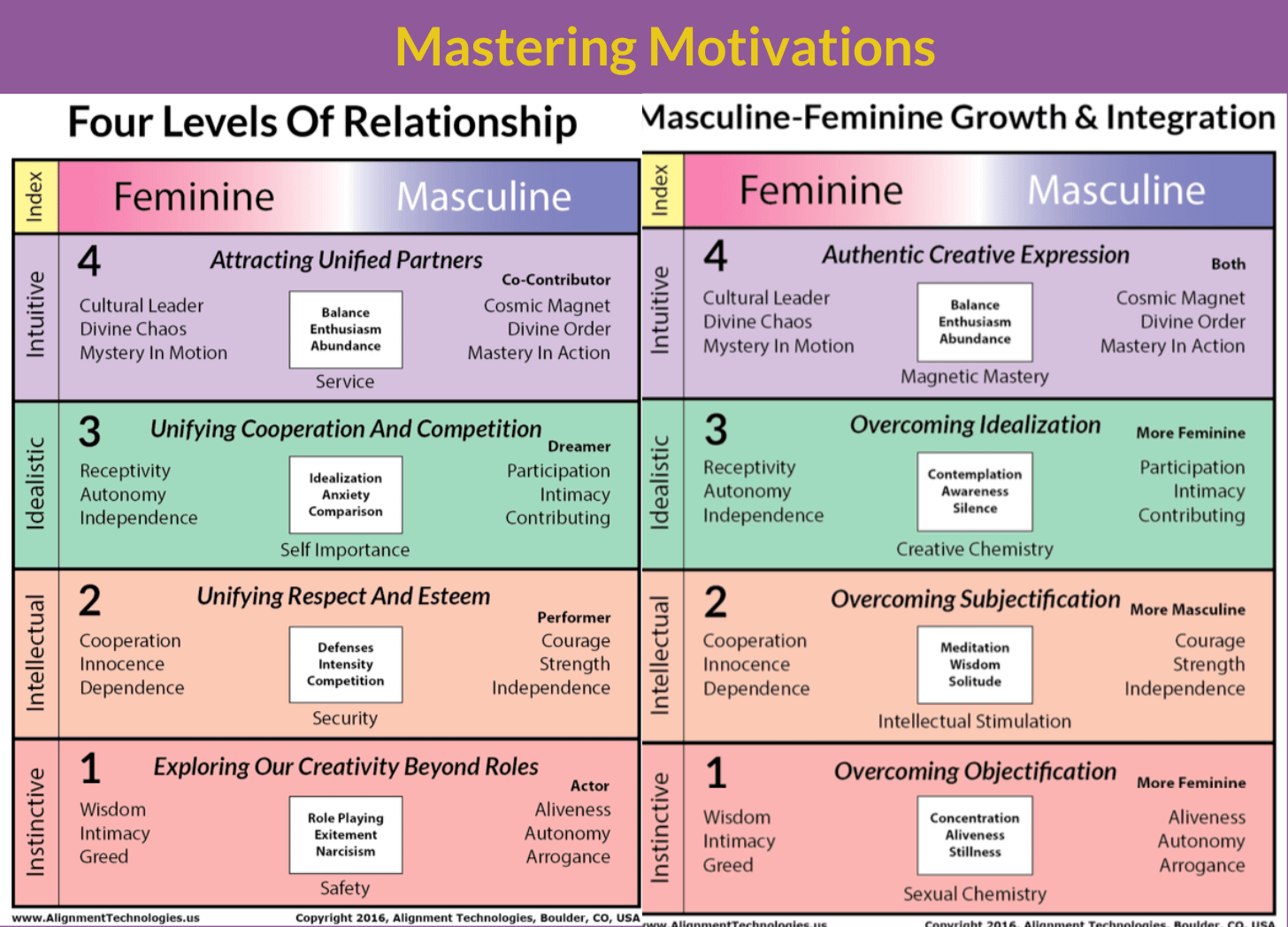
Feminine grows by deepening their ability to hold space as others move deeper — from Greed to Universal Dominion. We move from self-respect to mutual respect. Masculine grows by refining tools, time, and productivity — from Arrogance to Mutual Accomplishment. We move from self-esteem to mutual esteem.
When you master one side, you engage its opposite. It is not until we master the second Motive that we engage the unified Motive that completes this level, and we are released to move to another set of Motives. And you generate more intent, more energy, and more creative power. That’s how you move from Lust to Conscious Participation, building from no love, to personality love, to Radiant, Self Unifying Love.
The Benefit (For Now)
Beth and Steve aren’t saints yet. Sometimes they still slip into old patterns: she dreams without grounding; he schedules without spirit. But more often now, they pause and ask: “What Motive are we in right now?”
If they’re off-sync, they adjust. If they’re in sync, they run with it. And slowly, the selfish, self-focused Instinctive Motives fall away. The Intuitive Motives — especially Conscious Participation — become the new normal.
Because in the end, mastering Motives isn’t about fixing each other. It’s about becoming the kind of people who naturally make a positive impact — together.
We can see that Motives focus our energy.
Larry
Founder, Higher Alignment